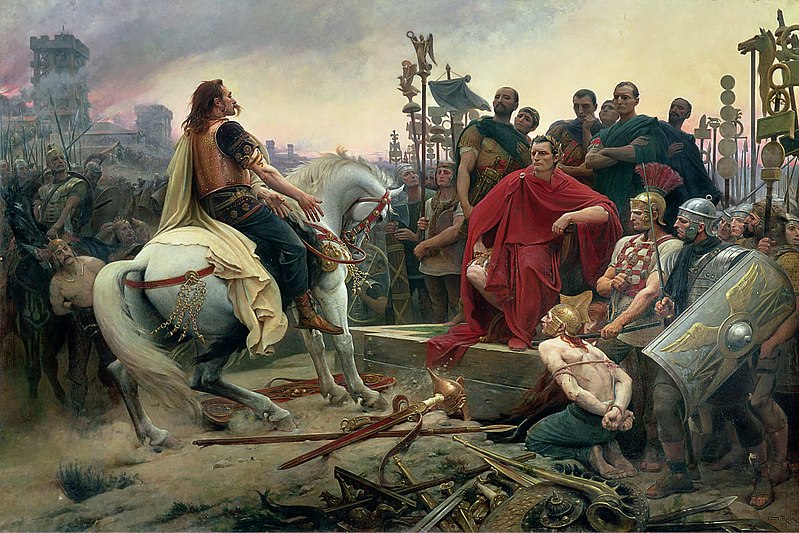
Gallic Wars
The Gallic Wars were a series of military campaigns waged by the Roman proconsul Julius Caesar against several Gallic tribes. Rome's war against the Gallic tribes lasted from 58 BC to 50 BC and culminated in the decisive Battle of Alesia in 52 BC, in which a complete Roman victory resulted in the expansion of the Roman Republic over the whole of Gaul (mainly present-day France and Belgium). While militarily just as strong as the Romans, the internal division between the Gallic tribes guaranteed an easy victory for Caesar, and Vercingetorix's attempt to unite the Gauls against Roman invasion came too late.[1][2] The wars paved the way for Julius Caesar to become the sole ruler of the Roman Republic.
Crassus, and Pompey formed a political alliance that dominated Roman politics for several years. Their attempts to amass power as Populares were opposed by the Optimates within theRoman Senate, among them Cato the Younger with the frequent support of Cicero. Caesar's victories in the Gallic Wars
These achievements granted him unmatched military power and threatened to eclipse the standing of Pompey, who had realigned himself with the Senate after the death of Crassus in 53 BC. With the Gallic Wars concluded
the Senate ordered Caesar to step down from his military command and return to Rome. Caesar refused the order, and instead marked his defiance in 49 BC by crossing the Rubicon with a legion, leaving his province and illegally entering Roman Italy under arms.[3] Civil war resulted, and Caesar's victory in the war put him in an unrivaled position of power and influence.
Crassus, and Pompey formed a political alliance that dominated Roman politics for several years. Their attempts to amass power as Populares were opposed by the Optimates within theRoman Senate, among them Cato the Younger with the frequent support of Cicero. Caesar's victories in the Gallic Wars
These achievements granted him unmatched military power and threatened to eclipse the standing of Pompey, who had realigned himself with the Senate after the death of Crassus in 53 BC. With the Gallic Wars concluded
the Senate ordered Caesar to step down from his military command and return to Rome. Caesar refused the order, and instead marked his defiance in 49 BC by crossing the Rubicon with a legion, leaving his province and illegally entering Roman Italy under arms.[3] Civil war resulted, and Caesar's victory in the war put him in an unrivaled position of power and influence.

No comments:
Post a Comment