102/100 BCE: Gaius Julius Caesar was born (by Caesarean section according to an unlikely legend) of Aurelia and Gaius Julius Caesar, a praetor. His family had noble, patrician roots, although they were neither rich nor influential in this period. His aunt Julia was the wife of Gaius Marius, leader of the Popular faction.
c. 85 BCE: His father died, and a few years later he was betrothed and possibly married to a wealthy young woman, Cossutia. This betrothal/marriage was soon broken off, and at age 18 he married Cornelia, the daughter of a prominent member of the Popular faction; she later bore him his only legitimate child, a daughter, Julia. When the Optimate dictator, Sulla, was in power, he ordered Caesar to divorce her; when Caesar refused, Sulla proscribed him (listed him among those to be executed), and Caesar went into hiding. Caesar's influential friends and relatives eventually got him a pardon.
c. 79 BCE: Caesar, on the staff of a military legate, was awarded the civic crown (oak leaves) for saving the life of a citizen in battle. His general sent him on an embassy to Nicomedes, the king of Bithynia, to obtain a fleet of ships; Caesar was successful, but subsequently he became the butt of gossip that he had persuaded the king (a homosexual) only by agreeing to sleep with him. When Sulla died in 78, Caesar returned to Rome and began a career as a orator/lawyer (throughout his life he was known as an eloquent speaker) and a life as an elegant man-about-town.
75 BCE: While sailing to Greece for further study, Caesar was kidnapped by Cilician pirates and held for ransom. When informed that they intended to ask for 20 talents, he is supposed to have insisted that he was worth at least 50. He maintained a friendly, joking relationship with the pirates while the money was being raised, but warned them that he would track them down and have them crucified after he was released. He did just that, with the help of volunteers, as a warning to other pirates, but he first cut their throats to lessen their suffering because they had treated him well.
72 BCE: Caesar was elected military tribune. (Note that Pompey and Crassus were the consuls for 70 BCE.)
69 BCE: He spoke at the funerals of both his aunt, Julia, and his wife, Cornelia. On both occasions, he emphasized his connections with Marius and the ancient nobility of his family, descended from the first kings on his mother's side and from the gods on his father's (revealing a notable talent for self-dramatization and a conception that there was something exceptional about him).
68/67 BCE: Caesar was elected quaestor and obtained a seat in the Senate; he married Pompeia, a granddaughter of Sulla. Caesar supported Gnaeus Pompey and helped him get an extraordinary generalship against the Mediterranean pirates, later extended to command of the war against King Mithridates in Asia Minor.
65 BCE: He was elected curule aedile and spent lavishly on games to win popular favor; large loans from Crassus made these expenditures possible. There were rumors that Caesar was having an affair with Gnaeus Pompey's wife, Mucia, as well as with the wives of other prominent men.
63 BCE: Caesar spent heavily in a successful effort to get elected pontifex maximus (chief priest); in 62 he was elected praetor. He divorced Pompeia because of her involvement in a scandal with another man, although the man had been acquitted in the law courts; Caesar is reported to have said, “The wife of Caesar must be above suspicion,” suggesting that he was so exceptional that anyone associated with him had to be free of any hint of scandal. In 61 he was sent to the province of Further Spain as propraetor.
60 BCE: He returned from Spain and joined with Pompey and Crassus in a loose coalition called by modern historians “The First Triumvirate” and by his enemies at the time “the three-headed monster.” In 62, Pompey had returned victorious from Asia, but had been unable to get the Senate to ratify his arrangements and to grant land to his veteran soldiers because he had disbanded his army on his return and Crassus was blocking his efforts. Caesar persuaded the two men to work together and promised to support their interests if they helped him get elected to the consulship.
59 BCE: Caesar was elected consul against heavy Optimate opposition led by Marcus Porcius Cato, a shrewd and extremely conservative politician. Caesar married his only daughter, Julia, to Pompey to consolidate their alliance; he himself married Calpurnia, the daughter of a leading member of the Popular faction. Caesar pushed Pompey's measures through, helped Crassus' proposals, and got for himself a five-year term as proconsul of Gaul after his consulship was over. However, he used some strong-arm methods in the Assembly and completely cowed his Optimate colleague in the consulship, Bibulus, so that jokers referred to the year as “the consulship of Julius and Caesar” (instead of “the consulship of Caesar and Bibulus”). Caesar was safe from prosecution for such actions as long as he held office, but once he became a private citizen again he could be prosecuted by his enemies in the Senate.
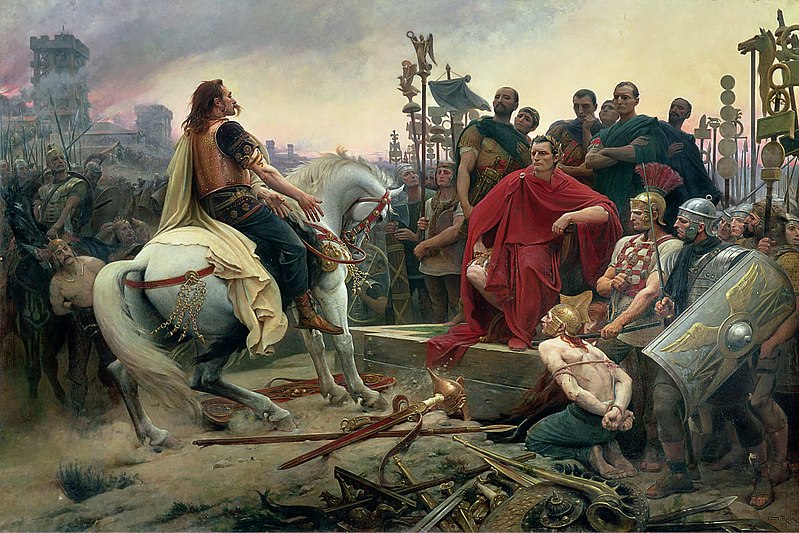
58 BCE: Caesar left Rome for Gaul; he would not return for 9 years, in the course of which he would conquer most of what is now central Europe, opening up these lands to Mediterranean civilization—a decisive act in world history. However, much of the conquest was an act of aggression prompted by personal ambition (not unlike the conquests of Alexander the Great). Fighting in the summers, he would return to Cisalpine Gaul (northern Italy) in the winters and manipulate Roman politics through his supporters (see this map of Caesar's Gallic campaigns).
56 BCE: Caesar, Pompey, and Crassus met in Caesar's province to renew their coalition, since Pompey had been increasingly moving toward the Optimate faction. Pompey and Crassus were to be consuls again, and Caesar's command in Gaul was extended until 49 BCE.
54 BCE: Caesar led a three-month expedition to Britain (the was the first Roman crossing of the English Channel), but he did not establish a permanent base there. Meanwhile, Caesar's coalition with Pompey was increasingly strained, especially after Julia died in childbirth in 54. In the following year, Crassus received command of the armies of the East but was defeated and killed by the Parthians.
52 BCE: Rioting in Rome led to Pompey's extra-legal election as “consul without a colleague.” Without Julia and Crassus, there was little to bond Caesar and Pompey together, and Pompey moved to the Optimate faction, since he had always been eager for the favor of the aristocrats.
51 BCE: The conquest of Gaul effectively completed, Caesar set up an efficient provincial administration to govern the vast territories; he published his history The Gallic Wars. The Optimates in Rome attempted to cut short Caesar's term as governor of Gaul and made it clear that he would be immediately prosecuted if he returned to Rome as a private citizen (Caesar wanted to run for the consulship in absentia so that he could not be prosecuted). Pompey and Caesar were maneuvered into a public split; neither could yield to the other without a loss of honor, dignity, and power.
49 BCE: Caesar tried to maintain his position legally, but when he was pushed to the limit he led his armies across the Rubicon River (the border of his province), which was automatic civil war. Pompey's legions were in Spain, so he and the Senate retreated to Brundisium and from there sailed to the East. Caesar quickly advanced to Rome, set up a rump Senate and had himself declared dictator. Throughout his campaign, Caesar practiced—and widely publicized—his policy of clemency (he would put no one to death and confiscate no property). In a bold, unexpected move, Caesar led his legions to Spain, to prevent Pompey's forces from joining him in the East; he allegedly declared, “I am off to meet an army without a leader; when I return, I shall meet a leader without an army.” After a remarkably short campaign, he returned to Rome and was elected consul, thus (relatively) legalizing his position.
48 BCE: Pompey and the Optimate faction had established a strong position in Greece by this time, and Caesar, in Brundisium, did not have sufficient ships to transport all his legions. He crossed with only about 20,000 men, leaving his chief legate, Mark Antony, in Brundisium to try to bring across the rest of the soldiers. After some rather desperate situations for Caesar, the rest of his forces finally landed, though they were greatly outnumbered by Pompey's men. In the final battle, on the plains of Pharsalus, it is estimated that Pompey had 46,000 men to Caesar's 21,000. By brilliant generalship, Caesar was victorious, though the toll was great on both sides; Caesar pardoned all Roman citizens who were captured, including Brutus, but Pompey escaped, fleeing to Egypt.
October 2, 48 BCE: Caesar, with no more than 4,000 legionaries, landed in Alexandria; he was presented, to his professed horror, with the head of Pompey, who had been betrayed by the Egyptians. Caesar demanded that the Egyptians pay him the 40 million sesterces he was owed because of his military support some years earlier for the previous ruler, Ptolemy XII (“The Flute Player”), who had put down a revolt against his rule with Caesar's help. After Ptolemy XII's death, the throne had passed to his oldest children, Cleopatra VII and Ptolemy XIII, as joint heirs. When Caesar landed, the eunuch Pothinus and the Egyptian general Achillas, acting on behalf of Ptolemy XIII (at this time about 12 years old), had recently driven Cleopatra (at this time about 20-21 years old) out of Alexandria. Cleopatra had herself smuggled into the palace in Alexandria wrapped in a rug (purportedly a gift for Caesar) and enlisted his help in her struggle to control the Egyptian throne. Like all the Ptolemies, Cleopatra was of Macedonian Greek descent; she was highly intelligent and well-educated. Caesar saw her as a useful ally as well as a captivating female, and he supported her right to the throne. Through the treachery of Pothinus and the hostility of the Egyptian people to the Romans, Achillas and an army of 20,000 besieged the palace. Caesar managed to hold the palace itself and the harbor; he had Pothinus executed as a traitor but allowed the young Ptolemy to join the army of Achillas. When he ordered the Egyptian fleet burnt, the great Library of Alexandria was accidently consumed in the flames.
Roman general and statesman Julius Caesar turned the Roman Republic into the powerful Roman Empire. A coup ended his reign, and his life, on the Ides of March.
Allegedly, a descendent of Trojan prince Aeneas, Julius Caesar's auspicious birth, c. July 12 or 13, 100 B.C., marked the beginning of a new chapter in Roman history. By age 31, Caesar had fought in several wars and become involved in Roman politics. After several alliances, he became dictator of the Roman Empire. This led to a senatorial coup, and Caesar's eventual assassination, on the Ides of March.
Early Years
A politically adept and popular leader of the Roman Republic, Julius Caesar significantly transformed what became known as the Roman Empire, by greatly expanding its geographic reach and establishing its imperial system.
While it has long been disputed, it's estimated that Julius Caesar was born in Rome on July 12 or 13, 100 BC. While he hailed from Roman aristocrats, his family was far from rich. When Caesar was 16 his father, Gaius Caesar, died. He remained close to his mother, Aurelia.
The Rome of Caesar's youth was unstable. An element of disorder ruled the Republic, which had discredited its nobility and seemed unable to handle its considerable size and influence.
At around the time of his father's death, Caesar made a concerted effort to side with the country's nobility. His marriage to Cornelia, the daughter of a noble, had drawn the ire of Rome's dictator, Sulla, who ordered the young Roman to divorce his wife or risk losing his property. Caesar refused and found escape in the military, serving first in the province of Asia and then in Cilicia.
Following the death of Sulla, Caesar returned to Rome to begin his career in politics as a prosecuting advocate. He relocated temporarily to Rhodes to study philosophy, but during his travels there was kidnapped by pirates. In a daring display of his negotiation and counter-insurgency tactics, he convinced his captors to raise his ransom. He then organized a naval force to attack them. The pirates were captured and executed.
His stature was enhanced further in 74 BC when he put together a private army and combated Mithradates VI Eupator, king of Pontus, who had declared war on Rome.
When Caesar returned to Rome he began to work with Pompey, a former lieutenant under Sully, who'd switched sides following the dictator's death. Not long after, in 68 or 69 BC, Caesar was elected quaestor (a base political office) and then went to serve in several other key government positions under Pompey.
His personal life meanwhile offered up tragedy when his wife, Cornelia, passed away in 69 BC. Two years later he remarried, taking Pompeia, a distant relative of Pompey, as his wife. Their marriage lasted just a few years, and in 62 BC the couple divorced.
Caesar's political ascendency, however, continued. In 61-60 BC he served as governor of the Roman province of Spain. He also continued his close alliance with Pompey, which enabled him to get elected as consul, a powerful government position, in 59 BC.
arly Rule
As Caesar was cultivating his political partnership with Pompey, the astute leader was also aligning himself with Marcus Licinius Crassus, a Roman general and politician who'd served valiantly during Sulla's rule.
Crassus proved to be instrumental in Caesar's rise to power. A leader himself, and cited as the wealthiest man in Roman history, Crassus offered financial and political support to Caesar.
Over the years Pompey and Crassus had come to be intense rivals. But once again Caesar displayed his abilities as a negotiator, earning the trust of both men and convincing them they'd be better suited as allies instead of enemies.
This partnership among the three men came to be known as the First Triumvirate. For Caesar, this political alliance and the power it gave him was the perfect springboard to greater domination.
n early controversial move came when he tried to pay off Pompey's soldiers by granting them public lands. While initially unpopular, Caesar hired a collection of Pompey's soldiers to stage a riot. In the midst of all the chaos, he got his way.
Not long after, Caesar secured the governorship of Gaul (now France and Belgium), allowing him to build a bigger military and begin the kind of campaigns that would cement his status as one of Rome's all-time great leaders. Between 58 and 50 BC, Caesar conquered the rest of Gaul, up to the river Rhine. As he expanded his reach, he also showed his ruthlessness with his enemies. In one instance he waited until his opponents' water supply had gone dry, and then ordered the hands of all the remaining survivors be cut off.
Even while he conquered Gaul, Caesar was mindful of the political scene back home, and he hired key political agents to act on his behalf in Rome.
But Pompey, who grew envious of his political partner's power and prestige, did not meet Caesar's growing stature with enthusiasm. Meanwhile, Crassus still had never completely overcome his disdain for Pompey. The three leaders patched things up temporarily in 56 BC at a conference in Luca that cemented Caesar's existing territorial rule for another five years, and granted Crassus a five-year term in Syria and Pompey a five-year term in Spain.
Three years later, however, Crassus was killed in a battle in Syria. Around this time Pompey revisited his old concerns about Caesar.
The Dictator
Through a series of events, Caesar eventually went to war against Pompey, leading troops across the river Rubicon on January 10-11, 49 BC. With Pompey further aligning himself with nobility, and the nobility increasingly seeing Caesar as a national threat, civil war proved to be inevitable.
But Pompey and his troops were no a match for Caesar and his military campaign. By the end of 48 BC, Caesar had pushed his enemies out of Italy and pursued Pompey into Egypt, where he was eventually killed. There, Caesar aligned himself with Cleopatra, with whom he had a son, Caesarion.
Upon his return to Rome, Caesar was made dictator for life and hailed as the Father of his Country. For Caesar and his countrymen, his rule proved instrumental in reforming Rome.
He would serve just a year's term before his assassination, but in that short period Caesar greatly transformed the empire. He relieved debt and reformed the Senate by increasing its size and opening it up so that it better represented Romans as a whole. He reformed the Roman calendar and reorganized how local government was constructed. In addition he resurrected two city-states, Carthage and Corinth, which had been destroyed by his predecessors, and he granted citizenship to a number of foreigners. He also proved to be a benevolent victor by inviting some of his defeated rivals to join him in the government.
But Caesar was also careful to solidify his power and rule. He stuffed the Senate with allies, and required the same body to grant him honors and titles. He was allowed to speak first at assembly meetings, and Roman coins bore his face.
/////////////////////////////